
Key takeaways
Why do sales roleplay exercises?
- Builds confidence and fluency before high-stakes calls
- Reveals knowledge gaps & coaching opportunities
- Makes coaching more active and memorable than passively reviewing scripts or decks
What’s included in this article:
- 6 ready-to-use sales roleplay exercises
- Prompts and real-world scenarios to try with your team
- Strategies for objection handling, negotiation, discovery, and navigating power structures
Sales roleplay best practices:
- Keep scenarios realistic and industry-specific
- Rotate roles: rep, buyer, manager, observer
- Record sessions to review and score performance
- Debrief after every exercise to reinforce learning
Who should use these tips:
- Sales managers and enablement teams
- Reps preparing for new product launches
- New hires in onboarding/training programs
- Teams moving to remote or hybrid sales
Pro tip:
Make roleplay a recurring habit — not a one-off exercise. Weekly or biweekly sessions can quickly improve win rates, confidence, and time-to-ramp for new reps.
6 key roleplay exercises to try with your sales reps
- Objection handling
- Negotiation
- Discovery
- Competition
- Buyer personas
- Getting to power
#1. How can reps practice handling common objections?
Objections are one of the toughest responses for reps to react to — that is, if they’re not adequately prepared.
You can design sales roleplay exercises that cover many of the common objections that the sales team receives (and has trouble handling) or tailor the exercise to a recent scenario that a rep dealt with.
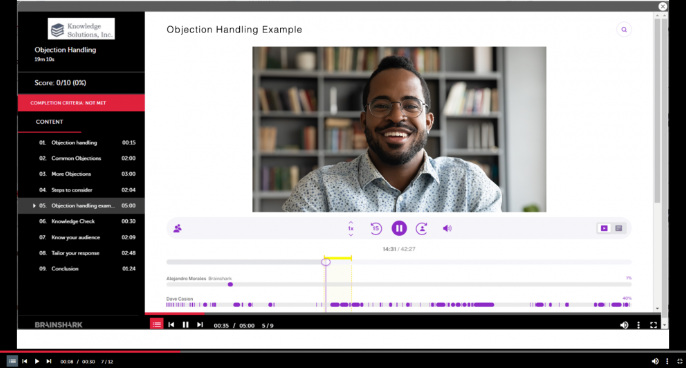
There are some fairly standard objections like pricing, but you will want to get feedback from your reps on which objections they hear most often from your customers, as these will vary from company to company.
A video coaching or virtual roleplay tool like the one pictured here makes it easy to scale roleplay exercises to multiple reps or even your whole sales team.
Example: Ask them to respond to a common buyer objection, such as, “I need more time to decide so I’ll be putting this decision on the back burner for another 6 months.”
Sales managers should respond to the role play by:
- Looking for a rep’s ability to transition from the objection and discover why the prospect is choosing the status quo.
- Providing a score and specific feedback, just as they would during an in-person role play exercise.
- Having the rep run their role play through a Coaching AI tool for more, objective feedback in addition to the manager or coaches’ comments for thorough coverage.
By issuing the question to multiple reps via video coaching, sales and/or enablement managers can also capture the best responses and send them out to the team afterwards as an evergreen, on-demand learning opportunity.
Sample roleplay script for objection handling
Rep: “Based on what we’ve discussed, I recommend moving forward with X solution. How does that sound?”
Buyer: “I’m interested — but the price seems high.”
Rep: “I understand. Many customers felt that way initially until they saw the ROI by the first quarter. Can I walk you through how this typically plays out?”
Buyer: “Maybe. But I’m not sure it’s the right time.”
Rep: “Fair point. What would need to happen for the timing to feel right?”
Common mistakes
- Discounting too quickly
- Getting defensive or argumentative
- Talking more than asking questions
- Treating objections as rejection rather than buying signals
How to score this exercise
| Criteria | What to Look For |
| Active listening | Rep rephrases and acknowledges objections |
| Open-ended questions | Keeps the conversation moving forward |
| Confidence | Avoids apologizing or discounting immediately |
| Reframing | Ties objection back to value |
| Closing loop | Ends with a clear next step |
Metrics and KPIs
- Objection-to-next-step conversion rate
- Average time before offering discount
- Confidence scores during coaching sessions
- Call conversion rate after objection handling
- Discounts per deal (trending down over time)
#2. How do you simulate a negotiation scenario without real risk?
Negotiations are challenging for most reps but if they’re not prepared to find a middle ground with the buyer, deals can easily stall.
Example: To practice these scenarios, create a role play simulating a buyer asking for a product discount based on a lower price they’ve received from a competitor. This can either be done live via video conference (and you can ask reps to raise their hands to respond) or through a video coaching activity.
Managers should look for reps to show that they understand how to use a “give and get” negotiation strategy, such as getting the buyer to commit to a longer subscription in exchange for lower price.
Sample negotiation script
Buyer: “We want it, but only if we get a 25% discount.”
Rep: “Sounds like budget is the biggest concern. What’s driving that constraint?”
Buyer: “Leadership wants to see ROI first.”
Rep: “If I can provide projections that justify the spend, would that help build the business case?”
Common mistakes
- Agreeing to discounts without exploring trade-offs
- Treating negotiation as win/lose
- Not involving finance or procurement early enough
Giving away concessions without asking for anything in return
How to score this exercise
| Criteria | What to Listen For |
| Value defense | Holds price without apologizing or discounting |
| Composure | No rambling or signaling stress |
| Trade-offs | Concessions are exchanged, not given away |
| Stakeholder awareness | Knows when to introduce other parties |
| Partnership framing | Focuses on long-term value, not one-time cost |
Metrics and KPIs
- Average discount percentage per deal
- Margin protection rate
- Number of meaningful trade-offs suggested
- Time to close after negotiation begins
- Win rate on deals where objections arise
#3. What’s the best way to roleplay a discovery call?
The discovery process will be successful if reps know how to ask good questions and confirm information they’re hearing. And since discovery is so crucial to moving deals forward, you’ll want to validate those skills within each individual rep.
Creating different role plays for each rep can help hone their individual discovery skills. Video coaching activities are a simple way to organize this because you can ask each rep to show how they’d respond to buyer personas with different trigger points.
Example questions:
- What are the top three discovery questions you would ask to identify the problem?
- What are some requirements based on the buyer’s company, industry or current situation?
Managers should look for reps to demonstrate that they can answer questions by summarizing the business challenge using your company’s sales methodology.
You can also design group role plays via video coaching to help reps navigate common discovery scenarios. Useful examples from this exercise can then be used as onboarding content.
Sample roleplay script for a discovery call
Rep: “How are you currently solving X challenge?”
Buyer: “We use spreadsheets, but it’s getting difficult to manage.”
Rep: “What happens when things fall through the cracks?”
Buyer: “We lose deals… but the team is used to it.”
Rep: “Have you estimated what that might be costing you?”
Common mistakes
- Asking rapid-fire questions without follow-up
- Jumping into product features
- Moving to the demo too early
- Ignoring emotional or financial impact
How to score this exercise
| Criteria | Good Signals |
| Depth of questioning | “Tell me more” and “What happens when…” |
| Curiosity | Genuine follow-up, not checklist-style questions |
| Logical flow | Problem → Impact → Existing solution → Gap |
| Empathy | Uses the buyer’s language, not sales jargon |
| Next steps | Clear summary and aligned action |
Metrics and KPIs
- Number of pain points discovered per call
- Talk time vs. buyer talk time (ideal: rep < 40%)
- Time before first mention of product
- Percentage of calls that reach a defined next step
- Call sentiment or tone analysis (if available)
#4. How should reps practice selling against competitors?
There are a variety of challenges that can arise when you’re contending with a competitor during the sales process, especially because many industries and markets have new players entering all the time and changing the landscape.
Sales role plays can help ensure reps are up to date when a buyer asks them about competition.
Example: If multiple reps have come up against a competitor that offers a similar product at a lower price but with lesser capabilities, create a group video coaching activity or ask reps to act out the scenario in your next meeting or training session.
The key for managers is to see if reps can highlight the power of your product’s capabilities and how they will help solve the buyer’s business challenges.
The best responses can be added to a training course or curriculum that covers key information about this competitor. Or you can ask reps that performed the best to act out the scenario in your next live or virtual training session.
Sample competitive comparison script
Buyer: “Competitor X is less expensive.”
Rep: “They come up often. In our experience, customers usually compare us in three areas. Do you want a quick breakdown of where each solution excels?”
Common mistakes
- Speaking negatively about competitors
- Relying on feature comparisons only
- Not knowing competitor strengths
- Sounding defensive when competitors are mentioned
How to score this exercise
| Criteria | What to Look For |
| Neutral tone | No negative comments about competitors |
| Value alignment | Strengths tied to buyer outcomes |
| Preparedness | Familiar with competitor gaps and claims |
| Positioning framework | Differentiates in 2–3 clear points |
| Closing questions | “Which criteria matter most to you?” |
Metrics and KPIs
- Win rate when competitors are named
- Deal cycle time versus specific competitors
- Usage of competitive battlecards or enablement content
- Objection handling success rate
- Enablement asset engagement per rep
#5. How can sales roleplays strengthen understanding of buyer personas and ICP?
Knowing your buyer personas and ICP (ideal customer profiles) and how to have effective conversations with each of them is an important skill for reps to have.
Example: To test reps’ skills, conduct a role play requiring them to tailor a conversation to a new or challenging persona.
For example, if you aren’t having luck getting in front of marketing leaders, assign a video coaching activity where reps should describe the persona’s top challenges and how your product can solve them.
Managers or enablement teams can also take the roleplay a step further by asking reps to submit a video of themselves (or recite it live via video conference) delivering a pitch that’s designed specifically for marketing leaders and evaluate how they were able to highlight areas of your product that would help that group reach their goals.
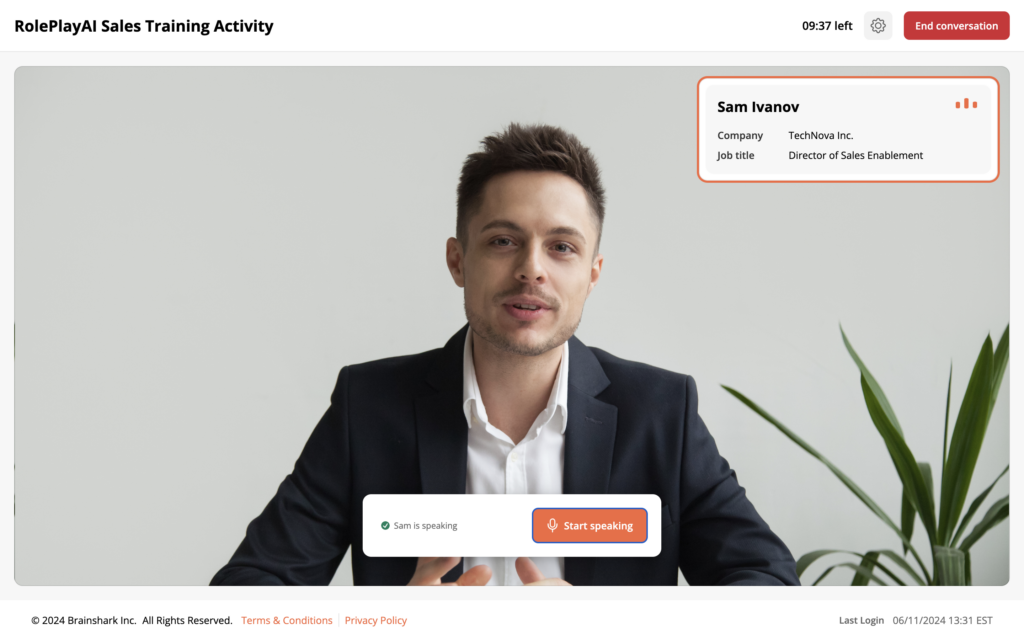
Sample persona roleplay
Persona: CFO — risk-averse and cost-focused
Rep: “I imagine forecasting and predictability are priorities for your role. When unexpected costs occur, how does that affect your planning?”
Buyer (as CFO): “It creates volatility every quarter.”
Rep: “Would reducing unplanned expenses by even 10% make a noticeable difference?”
Common mistakes
- Using a one-size-fits-all tone and message
- Confusing job title with persona
- Ignoring industry-specific concerns
- Trying to teach buyers what they already know
How to score this exercise
| Criteria | What Good Looks Like |
| Tone matching | Pace, language, and format fit the persona |
| Pain alignment | Problems connected to role-specific impact |
| Industry awareness | Understands context and vocabulary |
| Confidence | No hesitation when shifting personas |
| Flexibility | Can adapt tone mid-conversation if needed |
Metrics and KPIs
- Win rates by persona type
- Time-to-ramp across different buyer roles
- Persona-specific objection handling
- Confidence score per persona in coaching sessions
- Sentiment trends by persona type
#6. What happens when reps need to reach power or decision-makers?
A common hurdle in the sales process can be reps’ ability to “get to power” or speak to a decision-maker to accelerate deals.
Example: Sales roleplays that can help with this skill can be centered around ways to enable your champion to connect you to the decision-maker.
Assign a video coaching activity asking reps to demonstrate how they’d broach that subject with their champion.
After the coaching activity, managers can hold a team meeting to review the video responses, discuss whether the reps’ approaches were effective in ongoing deals and continue to hone best practice techniques as time goes on.
Sample escalation to decision maker script
Buyer: “I’ll pass this to leadership and get back to you.”
Rep: “That works. What questions do you think they’ll ask? We can walk through them now if that’s helpful.”
Buyer: “That could help.”
Rep: “If it saves time, I’m happy to join the next call and answer their objections directly. Would that be useful?”
Common mistakes
- Accepting weak handoffs without clarification
- Avoiding escalation due to fear of rejection
- Failing to prepare the internal champion
- Missing early signs of blockers or political risk
How to score this exercise
| Criteria | What Strong Reps Do |
| Champion enablement | Helps internal advocate make the case |
| Power mapping | Identifies influencers early |
| Clear request for access | Proactively asks to join the next call |
| Value framing | Positions escalation as support, not pressure |
| Risk awareness | Identifies blockers before they escalate |
Metrics and KPIs
- Multi-threaded opportunity rate
- Average number of stakeholders per deal
- Decision-maker meeting rate
- Deal velocity before and after escalation
- Win rate when decision-makers are involved early
Frequently Asked Questions (FAQ)
Q: How often should sales teams run roleplay exercises?
A: For best results, schedule roleplay sessions weekly or semimonthly. Consistent practice helps reps build confidence, retain skills, and improve objection handling over time. Even 30–45 minutes per session can make a measurable difference.
Q: Can roleplays work remotely?
A: Yes. Use video conferencing tools to simulate real sales calls, and consider screen sharing or collaborative whiteboards for scenario exercises. Record sessions for review and feedback. Remote roleplays are as effective as in-person ones when structured properly.
Q: What objections should we start with?
A: Begin with common, recurring objections your team faces, such as pricing, timing, product fit, or competitor comparisons. Start simple and gradually introduce more complex scenarios like multi-stakeholder negotiations or risk-averse buyers.
Q: How do you measure improvement after roleplay?
A: Track performance using metrics such as:
- Success in handling objections (objection-to-next-step conversion rate)
- Confidence scores in coaching evaluations
- Deal velocity and win rates
- Use of recommended scripts or frameworks
- Feedback from observers or managers after each session
Q: How can managers make roleplay sessions more effective?
A: Assign roles (rep, buyer, observer) to ensure every perspective is practiced. Use realistic scenarios, provide immediate feedback, and incorporate scoring or evaluation sheets. Debrief each exercise with clear takeaways and action items for improvement.
Q: Can roleplay exercises be adapted for new hires versus experienced reps?
A: Absolutely. For new hires, focus on foundational skills like discovery questioning and objection handling. For experienced reps, emphasize complex negotiations, persona-based selling, and multi-stakeholder engagement. Tailor difficulty to experience level for maximum benefit.
Get a demo of RolePlayAI to see how you can automate sales roleplay activities, scoring, reviews, and more.